Sensitivity analysis of a MAGiC ensemble
This tutorial runs the two sensitivity analyses of the MAGiC uncertainty workflow on a small demo dataset. The demo covers two design points: a corn field in the Sacramento-Delta and a woody perennial field in the San Joaquin Valley, over 2016 to 2023.
Both analyses use the inputs of an ensemble run: meteorology, initial conditions, management events, and the PFT priors. The local analysis moves each parameter in turn; the global analysis varies all four inputs together.
This documentation assumes that the steps in Environment setup have been completed. Run all commands below from the uncertainty repository root.
Fetch demo data
aws s3 cp s3://carb/data_raw/magic_uncertainty_demo_20260928.tgz demo-data/
mkdir -p demo-data/uncertainty
tar -xzf demo-data/magic_uncertainty_demo_20260928.tgz -C demo-data/uncertainty
aws s3 sync s3://carb/pfts/magic_v1.2/ demo-data/pfts/magic_v1.2/
cp demo-data/uncertainty/demo_config.yaml config.yaml
The demo package holds the ensemble inputs for the two design points:
site_info.csv: the design points, one row each, with their PFT and ERA5 grid celldata/ERA5_SIPNET/: 10 ERA5 meteorology members per grid cellIC_files/: initial condition members per design pointdata/events/: 20 management event members
The second download is the v1.2 parameterization package: one prior file per PFT, plus the package README.
Explore the CLI
./magic-uncertainty helpKey points:
prepare,local-sensitivity, andglobal-sensitivityeach run a fixed list of steps, and each step calls one script.- Every setting reaches a script as a command line argument; scripts do not read configuration files or environment variables.
--verboseprints the exact call issued for each step.- Each command writes a log to
run_dir.
Explore the configuration file
less config.yamlThe demo configuration uses these values:
run_dir: "uncertainty-demo-run/"
n_sites_local: 2
n_sites_global: 2
sobol_sample_size: 30
example_site: "328163"
n_workers: 4
workflow_parallelism_mode: local
pecan_parallelism_mode: local-gnu-parallel
n_sites_local and n_sites_global take the design points from the top of site_info.csv. sobol_sample_size is the base sample of the global analysis; each design point runs six times that number. pecan_parallelism_mode: local-gnu-parallel runs the model with GNU parallel in the current allocation, on n_workers cores. On a Slurm cluster, slurm-sbatch submits the runs as array jobs instead.
The external_paths block points at the downloaded inputs and at the SIPNET binary. Set sipnet_binary to the sipnet.git in your ensemble run directory.
Prepare
./magic-uncertainty prepare --verbose --config config.yaml- links the demo inputs into
run_dir, so large files are not copied - copies the two settings templates and inserts the run dispatch chosen in the configuration
- builds one settings file for each analysis, under
run_dir/local/andrun_dir/global/
Local sensitivity
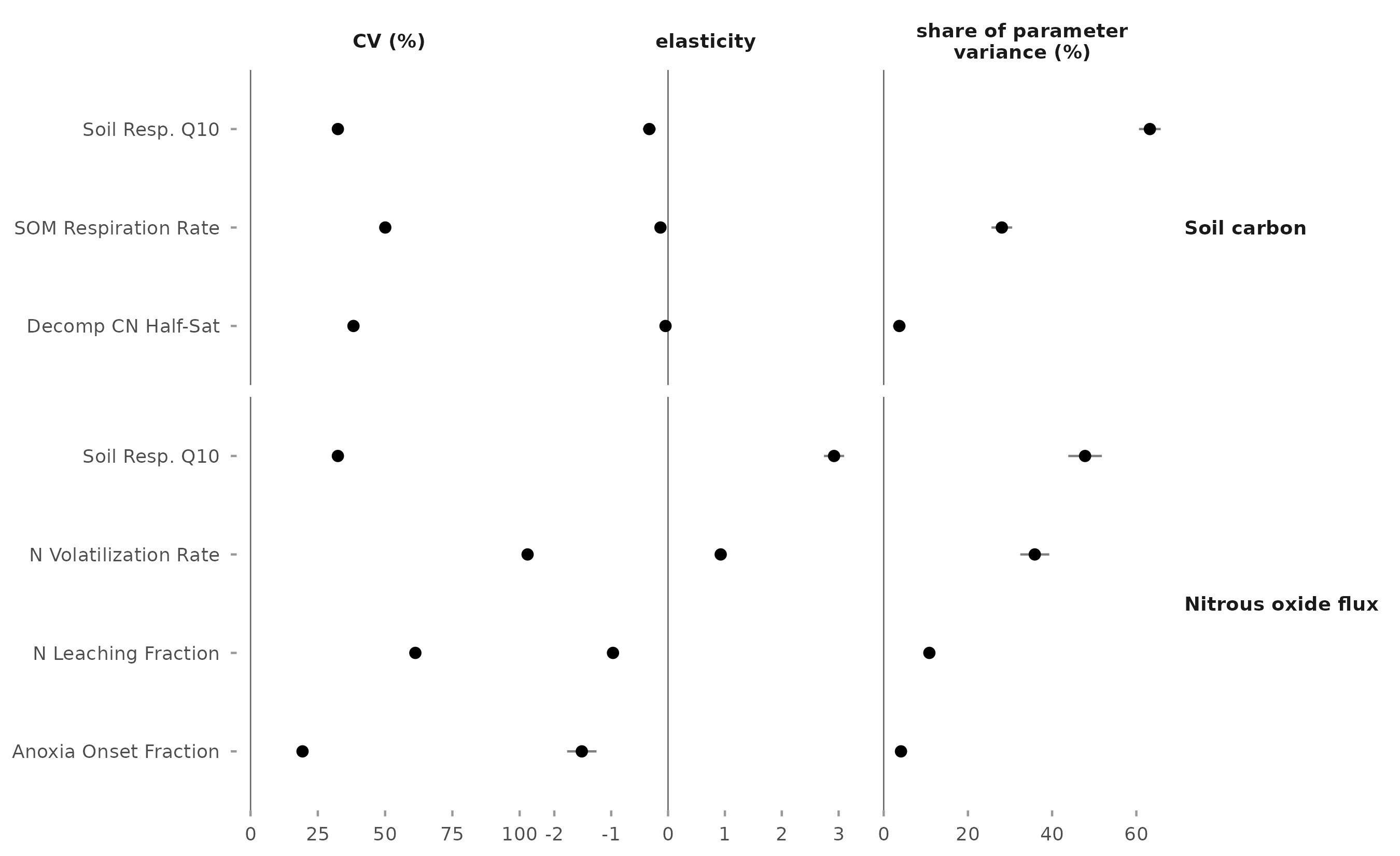
./magic-uncertainty local-sensitivity --verbose --config config.yamlSIPNET is run with every parameter at its prior median, then with each parameter moved in turn to four percentiles of its prior. That is 157 runs at the corn design point. The command then fits a spline through each parameter’s runs, computes each parameter’s share of the parameter variance at each design point, and draws the figures.
Results are in run_dir/local/: local_sensitivity.csv holds every parameter at every design point, and figures/ holds the report figures and parameter_shares.csv.
Global sensitivity
./magic-uncertainty global-sensitivity --verbose --config config.yamlThe command draws two samples of 30 rows, each row holding one draw of every parameter and one member of each input ensemble, and recombines them into a design of 180 rows. It runs SIPNET for every row at each design point, then computes the first-order and total-order index of each input with bootstrap intervals.
Results are in run_dir/global/: global_sensitivity.csv holds the indices and intervals, and figures/ holds the report figures and tables.
With a base sample of 30 the intervals are wide, and some estimates fall below 0 or above 1. The reported analysis uses a base sample of 1,000.
Scaling beyond the demo
The same three commands run the full analyses. Point external_paths at the inputs of a full ensemble run and set the sizes used in the reports:
n_sites_local: 100
n_sites_global: 10
sobol_sample_size: 1000
The local analysis then writes 13,364 runs and the global analysis 60,000. On a cluster, set pecan_parallelism_mode: slurm-sbatch so the model runs are submitted as array jobs, and run the CLI itself on a compute node with n_workers set to the cores available.